

BRUSSELS (CN) - European Commission President Ursula von der Leyen survived a no-confidence vote Thursday, but only after abandoning major policy priorities to prevent a humiliating coalition collapse, exposing deep political weakness at a critical moment for transatlantic relations.
The European Parliament rejected the motion of censure with 360 votes against, 175 in favor, and 18 abstentions. But the real cost came in the 150 billion euros ($165 billion) in policy reversals von der Leyen made just to secure basic support from her own centrist allies.
After the vote, von der Leyen posted on social media platform X: "In a moment of global volatility and unpredictability, the EU needs strength, vision, and the capacity to act. We need everyone to deliver on our common challenges. Together. As external forces seek to destabilize and divide us, it is our duty to respond in line with our values."
"Our vote doesn't mean that we are not critical of the European Commission," said Socialist leader Iratxe Garcia in a news release, highlighting the conditional nature of von der Leyen's victory.
Von der Leyen's domestic political crisis comes as the 27-member bloc faces what economists call an existential economic challenge. Former European Central Bank Governor Mario Draghi warned last year that Europe faces "slow agony" without massive reforms to compete with the U.S. and China, calling for 750-800 billion euros ($880-940 billion) in annual investment - nearly four times the current yearly EU budget.
The stakes have grown more urgent with Donald Trump's return to the White House, though recent diplomatic efforts offer cautious optimism. Trump has threatened tariffs of up to 50% on European exports, which totaled 531.6 billion euros ($624.0 billion) to the U.S. in 2024.
Hours before Thursday's vote, von der Leyen was forced to guarantee that the European Social Fund+ - Europe's main anti-poverty program - would remain in the EU's next seven-year budget after originally planning to redirect that money toward defense spending.
The abandoned defense pivot would have aligned with Trump's longstanding demands for European allies to boost military spending to counter threats from Russia and China. At NATO's June 2025 summit in The Hague, European allies agreed to Trump's demand to more than double defense spending from 2% to 5% of GDP by 2035 - a historic commitment that will require unprecedented fiscal effort.
To accommodate this massive spending increase, the EU has already shown willingness to break its own budget rules. In July, the European Council activated "national escape clauses" under the Stability and Growth Pact for 15 member states, allowing them to exceed normal deficit limits by up to 1.5% of GDP specifically for defense spending without triggering penalty procedures.
She also had to promise that cohesion policy funds - regional development payments worth $392 billion over seven years - would keep flowing directly to local authorities rather than through national governments.
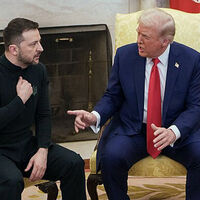
While the vote proceeded in Strasbourg, von der Leyen was in Rome at the Ukraine Recovery Conference, meeting with Ukrainian President Volodymyr Zelenskyy, German Chancellor Friedrich Merz, and U.S. officials including Ukraine envoy Keith Kellogg and Senator Lindsey Graham - highlighting how European political dysfunction now intersects with urgent transatlantic security cooperation.
Coalition fractures threaten US-EU coordination
The vote exposed dangerous fractures in von der Leyen's governing coalition that could paralyze European decision-making on trade, defense and technology policy crucial to U.S. interests. Out of 720 members of the European Parliament, 553 showed up to vote, with 167 absent - including some from groups that officially supported her.
The motion of censure, led by Romanian far-right lawmaker Gheorghe Piperea, centered on "Pfizergate" - von der Leyen's private text message negotiations with Pfizer CEO Albert Bourla during the Covid-19 pandemic. She negotiated the purchase of 1.8 billion vaccine doses worth 35 billion euros ($38.5 billion), and has refused to release those text messages for over two years despite court rulings that she breached EU transparency laws.
Von der Leyen's problems stem from abandoning her centrist coalition to work with far-right parties opposed to transatlantic cooperation. The breaking point came when her commission withdrew landmark anti-greenwashing legislation at the request of her own European People's Party, just one day after far-right groups led by Marine Le Pen and Viktor Orban demanded the same action.
Garcia set clear conditions for continued Socialist support, warning that von der Leyen's September State of the Union address - her annual speech to Parliament - would be "a turning point" requiring "real commitment" to social priorities.
Liberal Renew Europe lawmakers issued similar ultimatums, demanding a shift "from unilateralism to partnership." The convergence of these warnings signals that von der Leyen's September speech has become a make-or-break moment for her coalition.
Hungarian Prime Minister Viktor Orban, a frequent Trump ally, celebrated von der Leyen's troubles by posting "Time to go" on social media, calling the vote about "competence, results, and the future of Europe."
His attack came just one day after the commission issued fiscal recommendations urging Hungary to address its 4.9% budget deficit under the Excessive Deficit Procedure - the EU's process for countries that breach spending limits.
The controversy underscores a broader challenge for the EU: how to maintain credibility in demanding democratic standards from member states while facing questions about transparency and accountability within its own institutions.
No-confidence votes are rare in European politics - this was only the fourth motion of censure in EU history. While von der Leyen survived, the $165 billion in policy reversals she made to secure that survival, combined with her coalition's fragility, suggest that Europe's largest economic bloc may struggle to respond effectively to American pressure and Chinese competition in the years ahead.
Source: Courthouse News Service