

Giorgio Shani
Download PDF
Aug 9 2025
1
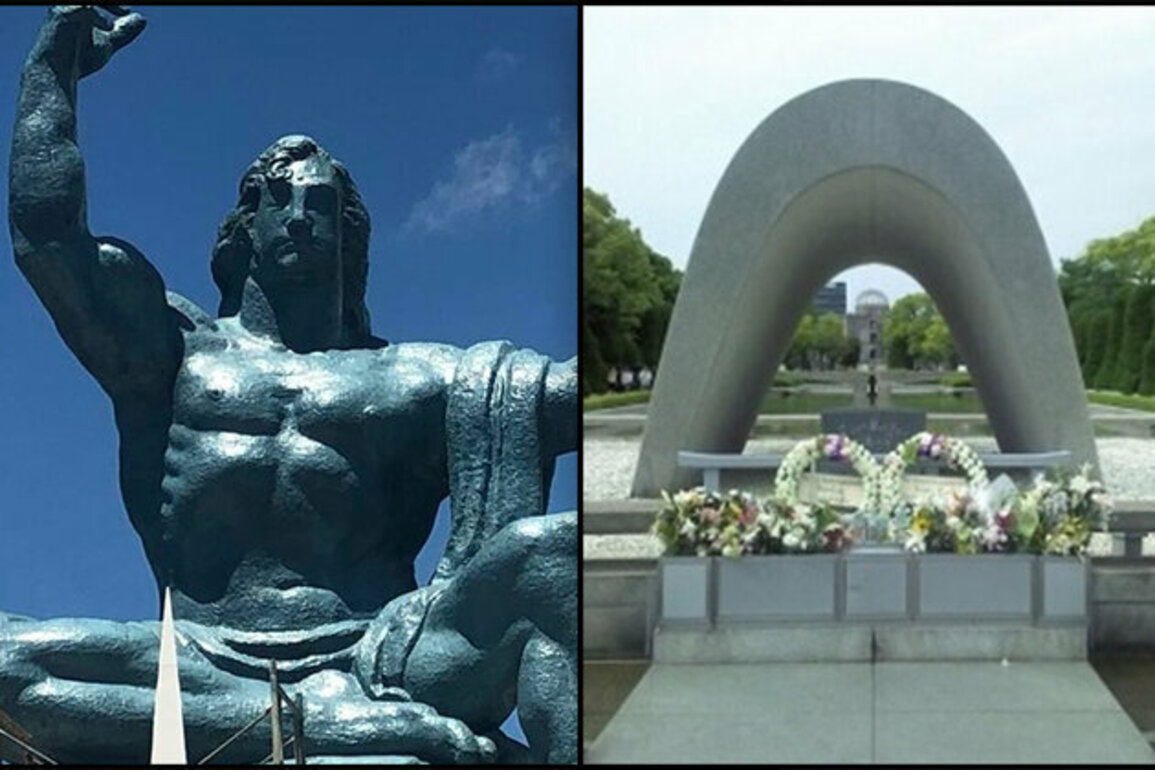
viewsNagasaki Peace Statue, Nagasaki Peace Park; Hiroshima Peace Memorial Park (Hiroshima Heiwa Kinen Koen). Photos by Giorgio ShaniThe official commemoration of the 80th anniversary of the atomic bombing of Hiroshima passed without incident. Senior politicians in black suits and ties delivered suitably somber speeches in front of similarly conservatively dressed visiting dignitaries. While the Mayor of Hiroshima Matsui Kazumi chided the international community for a flagrant disregard of thetragedies of historynoting that the former Cold War superpowers still possess 90% of all nuclear weapons, the Prime Minister of Japan, Ishiba Shigeru,stuck to the time-honored scriptof mourning the indiscriminate loss of life that August morning while refusing to blame the perpetrator. Refusing to blame the US for unleashing genocidal violence which killed 200,000 people from a B-29 against a civilian population in turn has allowed successive Japanese Prime Ministers from the ruling Liberal Democratic Party (LDP) to evade their nations responsibility for its own colonial andwartime atrocitiesinthe 15-year warit waged against its neighbours. Instead, blame has been displaced from the perpetrators onto humanity as a whole.
Hiroshima is a lesson for us all: its effects naturalized, and the US absolved of its war crimes. In Nagasaki, the epicentre of the bomb fell on Urakami Cathedral, the largest Catholic cathedral in Asia. Consequently,religious interpretationsdrawing on Nagasakis history of martyrdom and sacrifice came to resonate with official narratives of victimhood. Nagasaki became a sacrificial lamb to atone for the original sin of the nuclear age.
Unlike in Germany where defeat led to a partial de-Nazification yet rearmament and division during the Cold War, liberal democracy did not bring about remilitarization or the abolition of the imperial system but a weaponization of peace in the service of nationalism. Since Japan was the only nation to have suffered a nuclear holocaust and renounced the use of force underArticle 9 of its Constitution, it would forever be a model victim. Japan became a textbook case ofvictimhood nationalismand theHiroshima Peace Memorial Park(Hiroshima Heiwa Kinen Koen) from where the remembrance ceremony took place, and its counterpart in Nagasaki (Nagasaki Heiwa Koen),lieux de mmoirearound which Japan could be re-imagined. Lieux in this case denotes, following Pierre Nora, material and non-materials sites which have become thesymbolic heritageof a community: in this case, theimagined communityof Japan.
However, these lieux are also contested, and reclaimed, by the victims of the atomic bomb. The deserved award of the Nobel Prize in 2024 forNihon Hidankyo, an organization representing the survivors (Hibakusha)of Hiroshima and Nagasaki, unwittingly plays into this sense of victimhood nationalism yet contests it at the same time. Founded in 1956, Nihon Hidankyo has consistently demanded compensation from the Japanese state which they consider to be culpable forthe damage caused by the atomic bombsand have campaigned for the abolition of nuclear weapons worldwide. Their mobilization has led to legislation such as the A-Bomb Sufferers Medical Care Law in 1957 and the December 1994, the Law Concerning Relief to Atomic Bomb Survivors (A-Bomb Survivors Relief Law).
Yet, the provisions of these acts were not initially extended to non-Japanese subjects of the Japanese Empire who also were victims of the atomic bombs. There were approximately 140,000 Koreans living in Hiroshima at the time the atomic bomb was dropped. Many were working as forced laborers near the epicentre. Consequently, the mortality rate was relatively high.Koreans accounted collectively for 20% of the victims of the atomic bomb.After the war, most of Japans colonial minorities were repatriated as Japan was re-imagined as a homogenous nation (tanitsu minzoku); theEmperor was stripped of his divine authorityand his divinity conferred on the ethnos, an ethnically defined nation.
Embracing defeat, in John Dowers words, behind the US security umbrella did bring real benefits to the Japanese people in terms of rapid economic growthparticularly during the years of the Bubble economy in the 1980swhich until recently has taken the form of peace, secure employment, access to education, and social and affordable medical insurance. Even a 30-year decline and the triple disasters of March 11, 2011 (3.11) have failed to dent the social fabric upon which Japanese national identity draws sustenance, one based onKizuna,ties which have assumed the form of ethnic bonds. However, for many members of the lost post-Bubble generation, these bonds are unravelling, not because of economic decline, inflation or the piecemeal neo-liberalization of the economy, but because of a fearof migration and overtourism.T
his may explain the unanticipated success of the Sanseit party in the recent Upper House elections with their Japan First narrative which mirrors that of Trump and much of the global populist right. Sanseit have drawn support from the netto uyoku (Japans online far right): a younger, alienated, post-COVID generation who have grown up in isolation online and been socialised into an ecosystem ofconspiracy theoriesblaming foreigners, who make up3% of Japans declining population, for Japans woes.
In part, the Sanseit platform is not so very different from parties such as Nihon Ishin no Kai (Japan Innovation Party) and the more nationalist wing of the LDP which was represented by the late Japanese PM, Abe Shinzo. Abe bridged the divide between the pre-war and post-war periods, represented by his grandfather, the former PM Nobusuke Kishi, through a conservative nationalism centred on revising Article 9 and making Japan a normal andbeautifulcountry again. Initiatives such as theFree and Open Indo-Pacific (FOIP)were designed not only to bind Japan closer to the US in order to counter the threat of a rising PR China but also to assert Japans status as a regional power, capable of fulfilling its responsibilities to the US-led international community, within the constraints imposed by Article 9 (which has been eroded but still not yet been formally revised).
In conclusion, memories of the atomic bombing of Hiroshima and Nagasaki remain Japanscollective traumapermitting the Japanese nation to be imagined as a homogenous ethnic-based nation, a tanitsu minzoku, now under siege from the foreigners it badly needs for economic growth and recovery. By refusing to name the US as the perpetrator yet affirming Japans status as victim of the worlds only nuclear holocaust, post-war LDP governments absolved the US of its responsibility for the nuclear Armageddon it inflicted on Hiroshima and Nagasaki and pre-war elites of their responsibility for the atrocities committed under wartime and colonial rule:entwined atrocities. However, these memories are contested by groups such as Nihon Hidankyo which, while reproducing a narrative of victimhood nationalism, affirm that the real victims of the atomic bombing were the hibakusha of Hiroshima and Nagasaki including colonial minoritiesand not an ethnically homogenous imagined community that the conservative faction of the LDP and groups such as Sanseit claim to represent.
Further Reading on E-International Relations
- Strategic or Symbolic? Reassessing Hiroshima and Nagasaki Eighty Years On
- Opinion Japans 3/11: Ten Years On
- Opinion Reflecting on Hiroshima
- Global IR and Japan: What the Absence of the Debate Implies
- Opinion Shinzo Abes Murder and Japans History of Political Assassination
- Opinion Japan-South Korea Relations: Breaking the Cycle?
About The Author(s)
Giorgio Shaniis Professor and Chair of Politics and International Studies at International Christian University, Japan. He is author ofReligion, Identity and Human SecurityandSikh Nationalism and Identity in a Global Age; co-author ofSikh Nationalism;and co-editor ofRethinking PeaceandReligion and Nationalism in Asia. X@GiorgioShani.
TagsHiroshima NagasakiJapanNuclear Weapons