

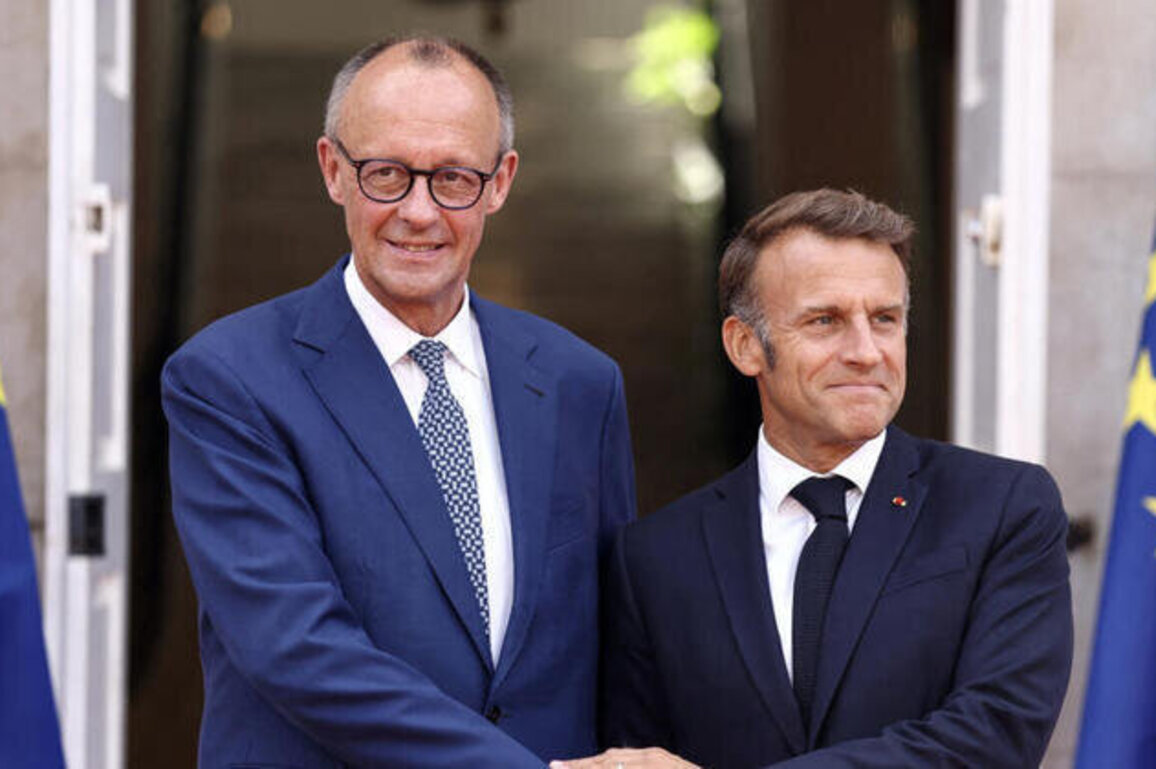
French PresidentEmmanuel Macronsaid Tuesday thatEuropedoes not want to be a "vassal" that is dependent on US and Chinese tech companies, calling for a "European preference" in the sector.
"Europe doesn't want to be the client of the big entrepreneurs or the big solutions being provided either from the US or from China, we clearly want to design our own solutions," Macron told a Berlin summit, adding that this stance represented "a refusal of being a vassal".
Macron was speaking at the European Summit on Digital Sovereignty that has brought together tech leaders and ministers from across the continent, including German ChancellorFriedrich Merz.
"I strongly believe that European preference needs to become our guiding principle, starting with public procurement," Macron said.
"Because guess what? The Chinese have a Chinese exclusivity ... and the Americans have a very strong American preference," he said.
He said there was a need for a change in emphasis when it comes to the EU's approach to legislation in the sector.
"We prioritised during the past few years regulation of our domestic players," Macron said. "We have to innovate before regulating".
He also underlined the stakes for Europe in having more autonomy in the tech sector.
"You cannot dedicate the strength of your economy to the 'Magnificent Seven'," he said, referring to American tech giants Alphabet, Amazon,Apple,Meta, Microsoft,NvidiaandTesla.
"More than that, you cannot delegate the whole functioning of your democracy to the (Magnificent Seven) ... it's unbearable," he went on, to applause from delegates.
Read moreThe unlikely success story of tech-giant ASML, the biggest backer of France's Mistral AI
With artificial intelligence set to play an increasingly important role in many sectors, Europe's leaders are responding to growing calls for the continentto take greater control of its own digital destiny.
Concerns about American tech dominance have also escalated since the return of US PresidentDonald Trump, who hasquestioned long-standing ties between the continent and Washingtonin many areas.
German Digital Minister Karsten Wildberger said Monday that the summit's "core message" would be that "Europe is ready to shape its own digital future, to reduce dependence".
"We can make better progress by working together," he added while attending a ground-breaking ceremony for an 11 billion ($12.8 billion) data centre outside Berlin.
Watch moreDigital euro inches closer to reality: Will Europeans trust a virtual currency?
TheEuropean Unionin particular has been criticised for moving too slowly in the battle for AI dominance against the United States andChina.
"The tectonic shifts we are currently witnessing in the world, in the political and economic centres of power, demand swift action in the digital sphere," German Chancellor Friedrich Merz said at the digital summit in Berlin on Tuesday.
"The questions of the future will be decided predominantly in the digital realm, and the US and China, two digital superpowers, are vying for technological leadership," he added.
"Europe must not cede this field to them."
The EU will propose a rollback of rules on AI and data protection later this week, a topic that is expected to feature prominently at the summit.
Both European businesses struggling to catch up and American tech giants have complained about the regulations, although the EU now stands accused of putting competitiveness before citizens' privacy.
Cloud computing concerns
Another topic of discussion in Berlin will be efforts to build up "sovereign" EU cloud computing capabilities. Proponents argue such facilities would better protect Europeans' data in a sector currently dominated by US firms likeGoogle, AWS andMicrosoft.
Fostering greater competition between industry and governments as well as creating "fair and efficient" digital markets will also be on the agenda.
Several announcements related to new digital initiatives are expected.
Watch moreA game changer for France's military: How AI is transforming the defence industry
As well as worries about US dependence, Europe has more long-standing concerns about reliance on firms from Communist Party-ruled China and other parts of Asia for hardware, from semiconductors to laptop components.
According to a survey by digital business association Bitkom, about 90 percent of German companies that import digital goods or services consider themselves dependent on them.
'Europe must invest'
Bitkom President Ralf Wintergerst said that Europe needed to urgently invest more in the digital sector.
"Europe must not fall behind today's investments secure tomorrow's competitiveness and jobs," he said. "If Europe does not want to become a museum of technology, we must ramp up investment significantly."
But the EU faces an uphill battle. It is struggling after a period of prolonged economic weakness and its tech firms remain far smaller than their US rivals.
As of last year the continent's data centres crucial for AI had computing capacity of just 16 gigawatts, compared with 48 in the US and 38 in China, according to a recent Bitkom study.
Andrecent investment announcements in Germanybillions of dollars from Google and a tie-up between US chip juggernautNvidiaand Deutsche Telekom for an industrial AI hub have only highlighted the continued dependence on American tech, critics say.
Despite the US-Europe tensions, a senior official from the French presidency said the summit was not about "confrontation" with the United States or evenChina.
Rather it is about "how we protect our core sovereignty and what rules need to be established, especially at the European level", said the official.
(FRANCE 24 with AFP, Reuters)
Originally published on France24