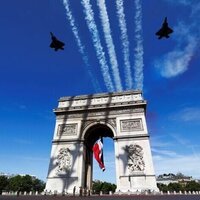


PARIS (CN) - France is gearing up to train 50,000 young volunteers in a bid to strengthen its army over the next decade. Polls show overwhelming support for the plan, and national media outlets are praising President Emmanuel Macron - who recently hit his lowest approval rating yet at roughly 11% - for taking action.
But experts argue the idea and its positive reception highlight a bigger shift in Europe's security paradigm. Russia is increasingly being perceived as a threat to nations across the continent, especially at a time when U.S. support is no longer guaranteed.
"It makes a lot of sense to send that signal now, where it becomes increasingly clear that Europe is facing extreme difficulties in coming up with sufficient deterrence without a credible American ally," Marius Strubenhoff, a policy analyst at the Centre for European Policy Network, said. "I think this threat feels a lot more urgent in Europe now than it felt last year."
Under Macron's plan, predominantly 18- and 19-year-olds could volunteer for a 10-month military program, including basic training and a monthly stipend. The volunteers would stay on French territory and could decide to join the reserve or enlist at the end of the term.
The program will roll out gradually, with 3,000 volunteers expected to start in 2026. This number is expected to grow to 10,000 by 2030, and 50,000 by 2035. Macron has been straightforward about the motivating factors behind the plan.
"The day that you send a signal of weakness to Russia, which for 10 years has made a strategic choice to become an imperial power again, that's to say advance wherever we are weak - well, it will continue to advance," he told the French radio station RTL on Nov. 25, two days before announcing the launch of the initiative.
European countries are contemplating ways to boost their defense capabilities, somewhat reversing a trend of previous years, said Giuseppe Spatafora, a research analyst at the EU Institute for Security Studies.
"This goes against a tendency in Europe toward reducing military service," he said. "That was the feature in many parts of Europe ... So in a very little period of time this decision basically might not necessarily be reversed, but it is being rethought, because if you think about 2010, it was a period in which there was no expectations of a large-scale conflict in Europe."
Spatafora pointed out that Macron had already floated this idea of voluntary military service during his first term, though more in the context of installing a sense of duty for young people. Today, the reasoning seems to have shifted.
"Now it is more of a realization that the European armies are depleted in many ways," he said. "And there's need for stronger forces, and especially to increase the basic skills and ability to defend."
Spatafora said Germany, for example, had conscription until it was suspended by former Chancellor Angela Merkel in 2011. The same goes for Poland, which shares a roughly 144-mile-long border with Russia and ended its draft in 2009. In November, Poland introduced a new voluntary program similar to France's but on a larger scale - it hopes to train 100,000 people by 2027.
Lithuania, which also shares a border with Russia, was on the verge of ending conscription, according to Spatafora. Ultimately the Baltic nation reversed course.
"It seems that there are more significant threats - the possibility that Russia could want to use military force to achieve certain objectives is becoming more real," Spatafora said. "We need to at least consider that possibility, and this doesn't mean that it will result necessarily in a war with all Europeans, against all Russians ... That's not necessarily the case, but you need to prepare the population for this possibility to happen."
In November, Fabien Mandon, the chief of staff of the French Armed Forces, sparked major controversy when he said the country should be ready to "accept losing its children" in the case of war. Politicians from both the extreme-right and extreme-left criticized the comment on X.
"You can't put the operational principles of the French army on its head overnight and turn it into a full conscription army," Strubenhoff said. "But introducing it on a voluntary basis and on a sort of small scale is kind of squaring that circle, if you will."
The voluntary element likely makes this a much easier pill to swallow than if the program was conscription based.
Alexandre Ammour, a 19-year-old student at the Sorbonne University in Paris, was waiting for the metro on Friday morning, contemplating the plan.
"I don't have much of an opinion, as long as it's optional it works for me," he said, leaning against the barrier to the train. "There is a threat [from Russia]; besides Ukraine we haven't had a war in Europe since the Yugoslavian war."
Nearby, another young man, who asked to go only by his first name, Victor, agreed that the voluntary element is critical.
"I watched a show on military service, and I think since it's on the basis of volunteers we can't really critique if everyone wants to do it or not," he said, adding that his father served in the military under conscription and had a positive experience. "I don't think there's a real risk from Russia, I'm not talking about Ukraine but Europe in general - maybe I'm wrong though."
Nicolas Tenzer, a senior fellow at the Center for European Policy Analysis' Democratic Resilience program, also thinks the voluntary military program is a good idea; it allows for training without the high cost of mandatory service.
"I think that's also a good test to the willingness of the people to serve the nation in the army," he said.
Tenzer wonders how NATO would come together in the event of a real conflict. He thinks Russian President Vladimir Putin could attack Estonia, Latvia or Lithuania in the coming years, which would test the strength of the alliance and its commitment to collective defense, known as Article 5.
"Are Europeans willing to abide by Article 5 of NATO and provide assistance to the country attacked by Russia?" he said. "Certainly, we perfectly know that the U.S won't go because we cannot trust the U.S. anymore - basically, I think that the transatlantic link is really broken."
Source: Courthouse News Service