


(CN) - After a year in office, German Chancellor Friedrich Merz is mired in a "polycrisis."
The economy is sputtering, the chancellor's popularity has plummeted and his massive rearmament plan is forcing unpopular cuts to social services and new taxes upon Germans. That's not all: He's arguing with allies, energy bills are rising as wars in Ukraine and the Middle East drag on and the far-right Alternative for Germany is ahead of his center-right Christian Democrats in the polls.
Germany is a textbook case of "polycrisis," a term popularized by British-American historian Adam Tooze to describe a situation where multiple crises interact and amplify one another, making them impossible to solve in isolation.
The array of problems facing Merz and Germany as a whole were laid bare Wednesday when his government, which includes the center-left Social Democrats, unveiled budget plans for the next four years. The budget calls for massive military spending coupled with cuts to healthcare and measures to ease the pain of rising energy costs. Still pending are possible cuts to pensions and tax hikes.
In a shock to German frugality, Wednesday's budget draft called for about 197 billion euros ($230 billion) in new debt next year with about 42.7 billion euros of that earmarked just for interest payments. Interest payments are expected to rise to about 78.7 billion euros by 2030, German media reported.
"This is all very bad ... very worrying," commented Veronika Grimm, an economist at the University of Technology Nuremberg.
In all, the government plans to spend 543.3 billion euros next year, 3.6% more than 2026.
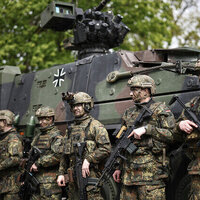
Last year, Germany's military spending rose by 24% and reached about $114 billion, putting it fourth in the world behind the United States, China and Russia, according to a recent report from the Stockholm International Peace Research Institute. By 2030, that figure is expected to double.
Overlapping threats
Just before Merz took office a year ago, Germany excluded spending on defense and infrastructure from its "debt brake" rule that limits borrowing to 0.35% of GDP.
The debt brake was written into Germany's constitution in the aftermath of the 2008 financial crisis as debt spiraled across the Western world. No other Group of Seven nation operated under such strict constraints.
Lifting that constraint paved the way for the spending blitz, which Merz and his allies called crucial to make up for years of underinvestment and to bolster Germany's military in the face of the danger posed by Russia and U.S. President Donald Trump's threats to withdraw from NATO.
Upon taking office, Merz, a 70-year-old former BlackRock executive and corporate lawyer, underwent a profound shift from steadfast believer in the debt brake to enthusiastic champion of public investment as the best way to deal with so many overlapping threats.
But it hasn't gone well for Merz, whose off-the-cuff remarks and sharp tongue have not helped him either.
The latest polls show Merz is deeply unpopular - and competing with French President Emmanuel Macron as Europe's least liked leader.
A recent poll for Bild newspaper found him the most unpopular of the country's top 20 politicians and that only about 10% of his own party's supporters had a positive view of him.
A poll conducted by the Sunday daily Bild am Sonntag newspaper found that 70% of eligible voters were dissatisfied with Merz's performance, while only 21% were satisfied.
Faced with anemic growth and massive spending plans, the Merz government faces tough choices - such as cutting social programs and raising taxes, measures likely to make Germans even more bitter.
On Wednesday, the government's budget called for an overhaul of Germany's statutory health insurance program to save 16 billion euros. The changes include higher copayments for medications, limits on free family coverage, bigger contributions for high-earners, no coverage for homeopathic medicines, the requirement for a second opinion for some surgeries, remuneration caps for doctors, hospitals and pharmaceutical companies and a tax on sugary drinks.
The war in the Middle East has worsened Germany's dire economic situation with the government slashing its growth forecast for this year to only 0.5%, down from a prior estimate of 1%.
After several years of sluggish growth, Germany is struggling with budget shortfalls and plugged holes from funds raised through borrowing meant for infrastructure improvements, recent reports showed.
In March, two of Germany's leading research institutes warned the spending blitz was at risk of being wasted.
"We have found that policymakers have used almost all of the debt-financed funds for other purposes, namely, to cover budget shortfalls. This is a major problem," said Clemens Fuest, the head of the Ifo Institute, as reported by Politico.
A fragile coalition
Meanwhile, Merz and the Social Democrats are struggling to agree on how to slash the budget by 60 billion euros.
Things got ugly on April 12 when Merz and Finance Minister Lars Klingbeil, a leader of the Social Democrats, met to discuss the budget at the Villa Borsig in Berlin.
Afterward, Klingbeil accused Merz of shouting at him when he rejected the conservatives' ideas to abolish May 1 as a public holiday and to allow employers to forgo paying the first day of a worker's sick leave.
By Wednesday, Merz and Klingbeil said they were united and downplayed the confrontation at the Villa Borsig. Still, doubts swirled whether the coalition could stay together until its mandate ends in the fall of 2029.
One of Merz's own top party members, Christian von Stetten, gave the coalition government only a few months to turn the dire situation around or face collapse, German media reported.
"It's perfectly clear that the country is at its limit, as are businesses and citizens," he said. "If we're already discussing new debt and higher taxes again, then we're going in completely the wrong direction."
Meanwhile, as the government fumbles ahead amid so many crises, the far-right Alternative for Germany, or AfD, has gained in support with the latest polls clearly showing it has pulled ahead of the Christian Democrats.
On Tuesday, a Forsa poll showed the AfD ahead of the Christian Democrats by its widest margin ever. The poll found support for AfD at 27% and the Christian Democrats at 22%. The Social Democrats trailed at 12%.
The AfD is on track to win an outright majority in September regional elections in the eastern state of Saxony-Anhalt. No far-right party has held power in a German state or federal government since the end of World War II.
Merz is showing signs of being rattled.
This week, Merz caused a stir when he said the United States had been "humiliated" by Iran's regime and that Washington's lack of a strategy to end the war was hurting Germany's economy as energy prices surge.
"It's costing us a lot of money - a lot of taxpayer money - and it's costing us a lot of economic strength," Merz said. "This war against Iran has a direct impact on our economic performance, and for that reason it must be brought to an end as soon as possible."
Trump hit back on social media, saying Merz "doesn't know what he's talking about! ... No wonder Germany is doing so poorly, both economically, and otherwise!"
Meanwhile, Merz is attacking the EU too, accusing it of hurting Europe's competitiveness through excessive regulation. In discussions over the EU's next multiyear budget, Germany is calling for spending cuts and a reduction in red tape.
Courthouse News reporter Cain Burdeau is based in the European Union.
Source: Courthouse News Service